Unit 1: Solutions
Homogeneous mixtures of two or more components — the basis for many biological and industrial processes
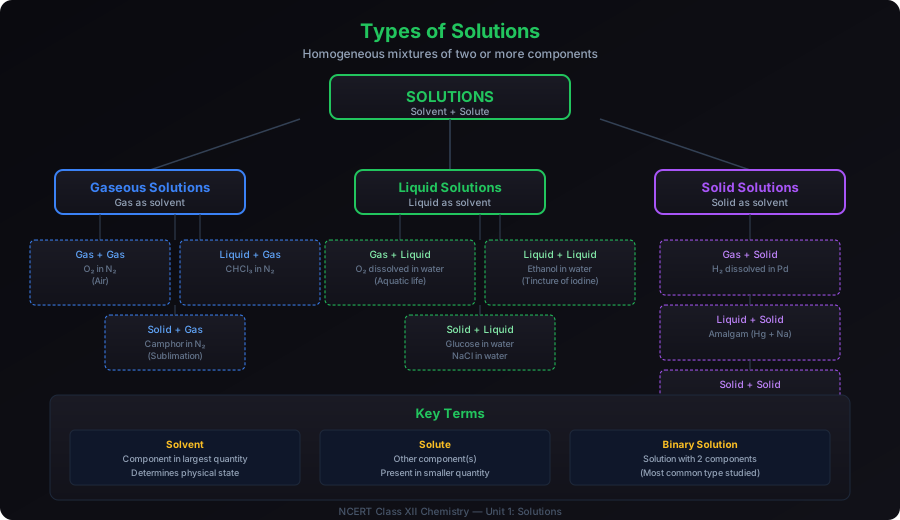
1.1 Types of Solutions
Solutions are homogeneous mixtures where composition and properties are uniform throughout. The component present in largest quantity is the solvent, and others are solutes.
Concentration Units
| Unit | Formula | Temperature Dependent? |
|---|---|---|
| Mass % (w/w) | (Mass of component / Total mass) × 100 | No |
| Volume % (V/V) | (Volume of component / Total volume) × 100 | No |
| Parts per million (ppm) | (Parts of component / Total parts) × 10⁶ | No |
| Mole fraction (x) | xₐ = nₐ / (nₐ + nᵦ) | No |
| Molarity (M) | Moles of solute / Volume of solution (L) | Yes |
| Molality (m) | Moles of solute / Mass of solvent (kg) | No |
1.2 Solubility
Solubility is the maximum amount of solute that can dissolve in a given amount of solvent at a given temperature and pressure.
Solubility of Solids in Liquids
- Polar solutes dissolve in polar solvents ("like dissolves like")
- If dissolution is endothermic (ΔₛₒₗH > 0), solubility ↑ with ↑ temperature
- If dissolution is exothermic (ΔₛₒₗH < 0), solubility ↓ with ↑ temperature
- Pressure has negligible effect on solid solubility
Solubility of Gases in Liquids — Henry's Law
Gas solubility increases with pressure and decreases with temperature.
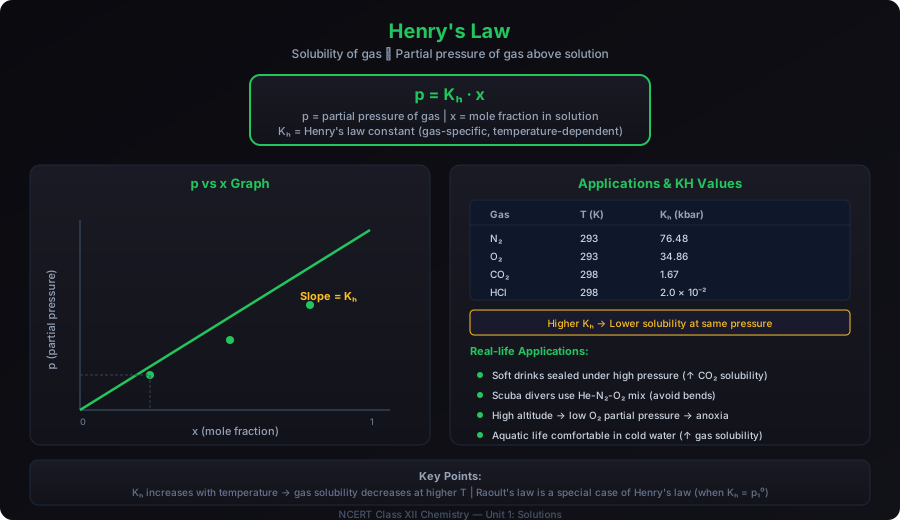
Applications: Soft drinks (CO₂ sealed under pressure), scuba diving (He-N₂-O₂ mix to avoid bends), aquatic life in cold water.
1.3 Raoult's Law
For solutions of volatile liquids, the partial vapor pressure of each component is proportional to its mole fraction in solution.
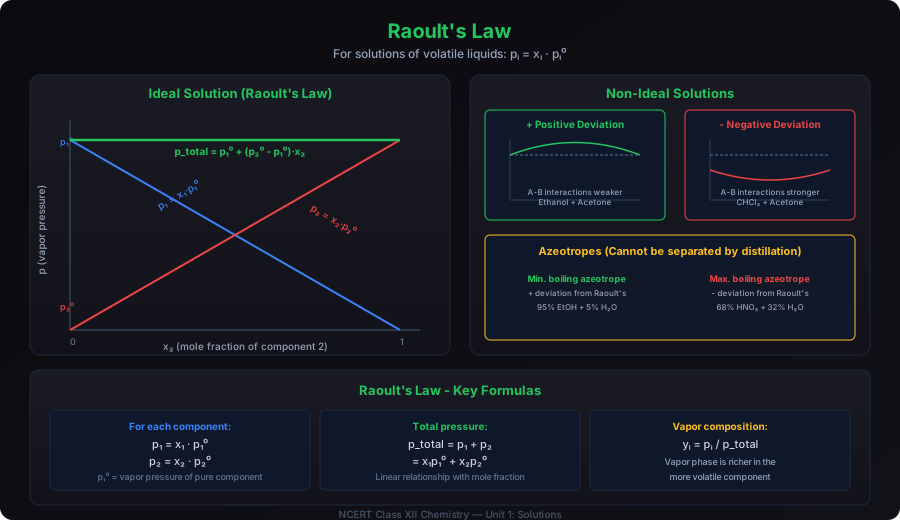
Total pressure: p_total = x₁p₁⁰ + x₂p₂⁰
Raoult's law is a special case of Henry's law when Kₕ = p₁⁰.
Ideal vs Non-Ideal Solutions
| Property | Ideal Solution | Non-Ideal Solution |
|---|---|---|
| Raoult's Law | Obeys over entire range | Deviation from Raoult's law |
| ΔₘᵢₓH | = 0 | ≠ 0 |
| ΔₘᵢₓV | = 0 | ≠ 0 |
| Interactions | A-A ≈ B-B ≈ A-B | A-B ≠ A-A or B-B |
| Examples | n-Hexane + n-Heptane, Benzene + Toluene | Ethanol + Acetone (+), CHCl₃ + Acetone (−) |
Azeotropes
- Minimum boiling azeotrope: Large + deviation (e.g., 95% ethanol + 5% water)
- Maximum boiling azeotrope: Large − deviation (e.g., 68% HNO₃ + 32% water)
- Cannot be separated by fractional distillation
1.4 Colligative Properties
Properties that depend on the number of solute particles, not their identity. There are four colligative properties.
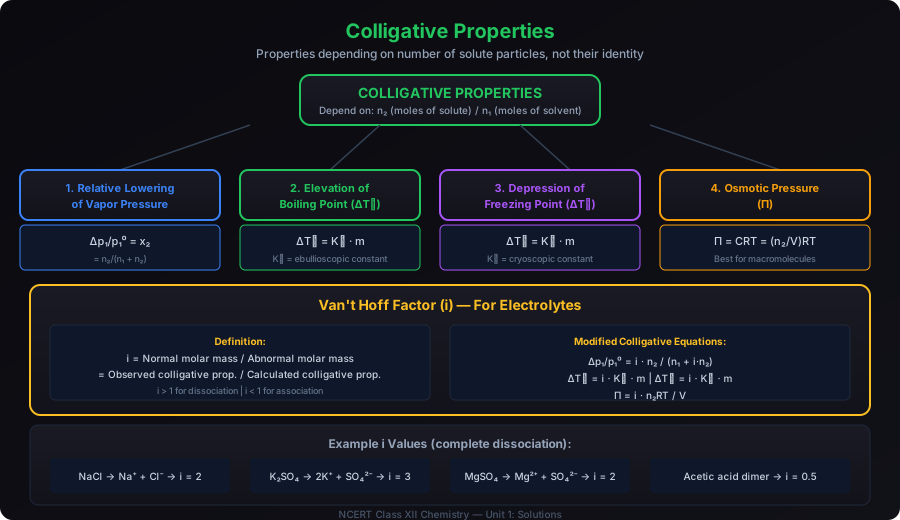
1. Relative Lowering of Vapor Pressure
2. Elevation of Boiling Point
Where Kᵦ = molal elevation constant (K kg mol⁻¹), m = molality. For water, Kᵦ = 0.52 K kg mol⁻¹.
3. Depression of Freezing Point
Where K𝒻 = molal depression constant. For water, K𝒻 = 1.86 K kg mol⁻¹.
4. Osmotic Pressure
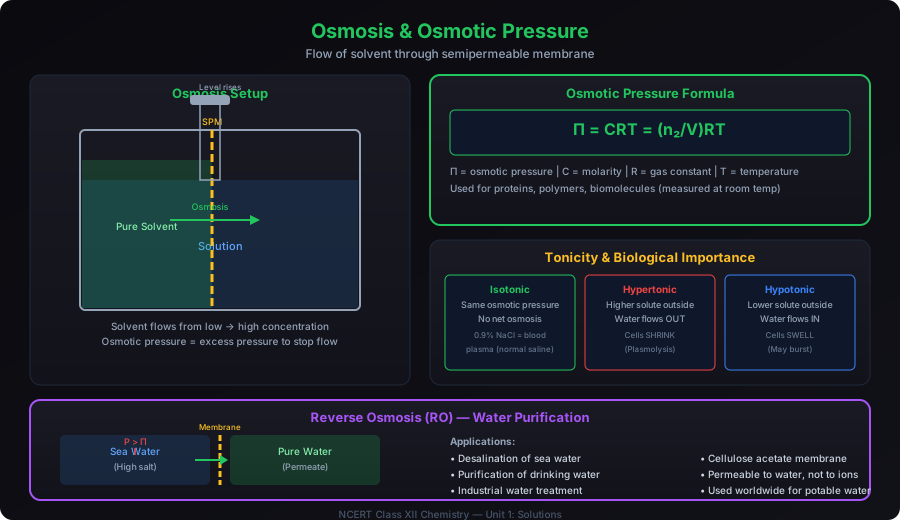
- Measured at room temperature (unlike boiling/freezing methods)
- Large magnitude even for very dilute solutions
- Biomolecules are stable at room temperature
Isotonic, Hypertonic, Hypotonic Solutions
- Isotonic: Same osmotic pressure (e.g., 0.9% NaCl = blood plasma → safe for IV)
- Hypertonic: Higher solute outside → water flows OUT → cells shrink
- Hypotonic: Lower solute outside → water flows IN → cells swell
1.5 Abnormal Molar Masses — Van't Hoff Factor
Electrolytes dissociate into ions, increasing the number of particles. Some molecules associate (dimers), decreasing particles. This causes abnormal molar masses.
i = Normal molar mass / Abnormal molar mass = Observed colligative prop. / Calculated colligative prop.
Modified equations:
ΔTᵦ = i · Kᵦ · m | ΔT𝒻 = i · K𝒻 · m | Π = i · n₂RT / V
i > 1 for dissociation (e.g., NaCl → i ≈ 2) | i < 1 for association (e.g., acetic acid dimer → i ≈ 0.5)
| Salt | i (0.001 m) | Complete Dissociation i |
|---|---|---|
| NaCl | 1.97 | 2 |
| KCl | 1.98 | 2 |
| MgSO₄ | 1.82 | 2 |
| K₂SO₄ | 2.84 | 3 |
Summary
Solutions are classified by physical state of solute and solvent. Concentration is expressed in multiple units. Henry's law relates gas solubility to pressure. Raoult's law gives vapor pressure of ideal solutions. Colligative properties (vapor pressure lowering, boiling point elevation, freezing point depression, osmotic pressure) depend on number of solute particles. Van't Hoff factor accounts for dissociation/association of electrolytes.