Unit 8: Organic Chemistry — Some Basic Principles and Techniques
The study of carbon compounds — their bonding, classification, nomenclature, and reaction mechanisms
8.1 Tetravalence of Carbon
Carbon forms four covalent bonds due to its electronic configuration 1s² 2s² 2p². The four valence electrons allow carbon to achieve a stable octet by sharing electrons with other atoms.
Hybridisation and Shapes

sp³ (Tetrahedral)
Bond angle 109.5°. Four single bonds. E.g., CH₄, C₂H₆.
sp² (Trigonal Planar)
Bond angle 120°. One double bond. E.g., C₂H₄, C₆H₆.
sp (Linear)
Bond angle 180°. One triple bond or two double bonds. E.g., C₂H₂.
8.2 Structural Representations
Organic molecules can be represented in several ways, from complete Lewis structures to simplified bond-line (skeletal) formulas.
- Complete (Lewis): Shows all bonds and all atoms
- Condensed: Groups atoms together (e.g., CH₃CH₂OH)
- Bond-line (Skeletal): Lines represent bonds; C and H are implied
- Wedge-Dash: Shows 3D arrangement — solid wedge = towards viewer, dashed = away
8.3 Classification of Organic Compounds
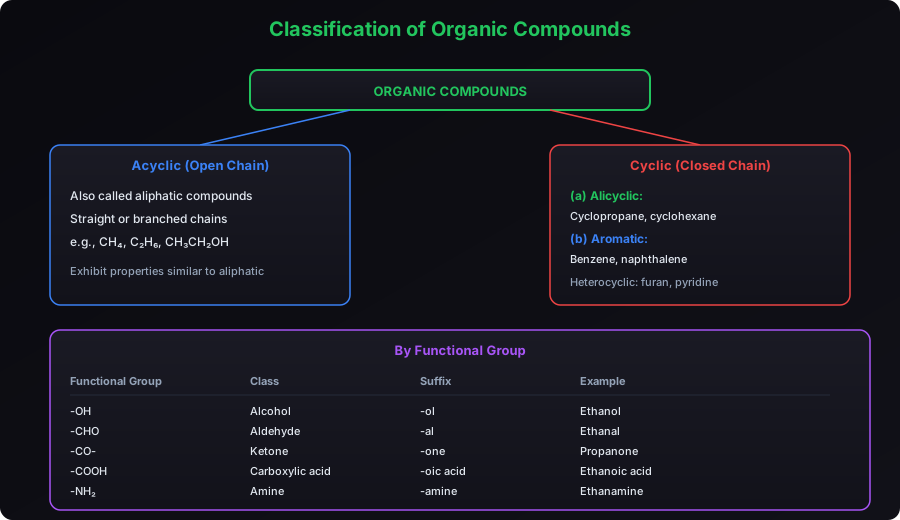
Acyclic (Open Chain)
Carbon chains — straight or branched. Also called aliphatic.
Cyclic (Closed Chain)
Rings: alicyclic (e.g., cyclohexane) or aromatic (e.g., benzene).
Homologous Series
Same functional group, differing by —CH₂— units. Similar chemical properties, gradual physical changes.
8.4 Functional Groups
Functional groups determine the chemical behaviour of organic compounds. Common functional groups and their classes:
| Functional Group | Class | IUPAC Suffix | General Formula |
|---|---|---|---|
| —OH (hydroxyl) | Alcohol | -ol | R-OH |
| —CHO (formyl) | Aldehyde | -al | R-CHO |
| —CO— (carbonyl) | Ketone | -one | R-CO-R' |
| —COOH (carboxyl) | Carboxylic acid | -oic acid | R-COOH |
| —NH₂ (amino) | Amine | -amine | R-NH₂ |
| —COOR (ester) | Ester | -oate | R-COO-R' |
| —O— (ether) | Ether | alkoxyalkane | R-O-R' |
8.5 IUPAC Nomenclature
IUPAC rules provide a systematic method to name organic compounds:
- Longest chain: Identify the longest carbon chain as parent (e.g., ethane, propane, butane)
- Numbering: Start from the end giving the lowest locant to substituents or functional group
- Prefix: Name and locate substituents (e.g., 2-methyl, 3-ethyl)
- Suffix: Add functional group suffix to parent name (e.g., -ol, -al, -one, -oic acid)
- Multiples: Use di-, tri-, tetra- for repeated substituents
8.6 Isomerism
Compounds with the same molecular formula but different structures are isomers. Two main types:
Structural (Constitutional)
Different connectivity of atoms. Types: chain, position, functional group, metamerism, tautomerism.
Stereoisomerism
Same connectivity but different spatial arrangement. Types: geometrical (cis-trans), optical (enantiomers).
8.7 Electronic Displacements
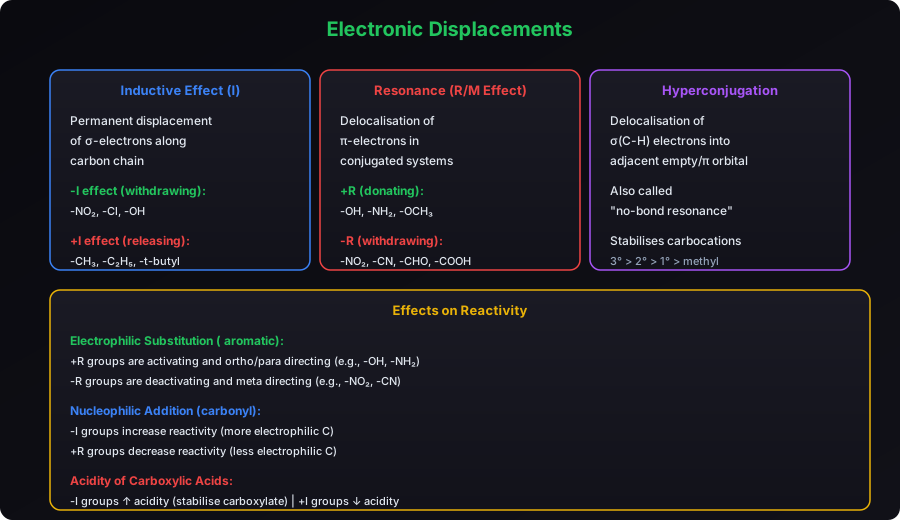
Inductive Effect
Permanent displacement of σ-electrons along a C-C bond due to electronegativity differences. +I effect: electron-releasing groups (alkyl groups). −I effect: electron-withdrawing groups (—NO₂, —Cl, —OH).
Resonance (Mesomeric Effect)
Delocalisation of π-electrons in conjugated systems. +R effect: groups donating electrons (—OH, —NH₂). −R effect: groups withdrawing electrons (—NO₂, —CN, —CHO).
Hyperconjugation
Delocalisation of σ(C-H) electrons into an adjacent empty or partially filled p-orbital or π* orbital. Also called "no-bond resonance." Stabilises carbocations: 3° > 2° > 1° > methyl.
8.8 Types of Organic Reactions
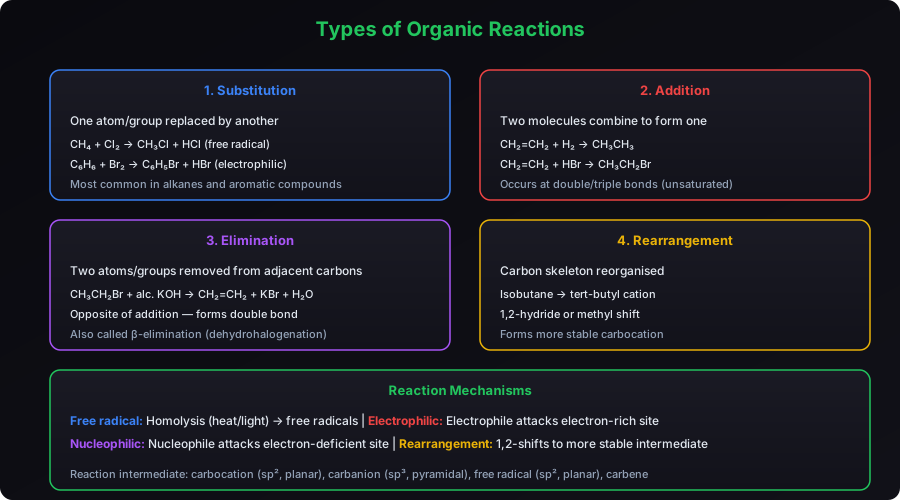
Substitution
An atom/group is replaced by another. Most common in alkanes and aromatic compounds.
Addition
Two molecules combine at a double/triple bond. Opposite of elimination.
Elimination
Two atoms/groups removed from adjacent carbons to form a double bond.
Rearrangement
Carbon skeleton reorganised via 1,2-shifts to form a more stable intermediate.
Reaction Mechanisms
Organic reactions proceed via intermediates. Key types:
- Free radical: Homolysis (heat/light) → free radicals → chain mechanism
- Electrophilic: Electrophile attacks electron-rich site (e.g., aromatic substitution)
- Nucleophilic: Nucleophile attacks electron-deficient site (e.g., carbonyl addition)
Key intermediates: carbocation (sp², planar, 6 valence e⁻), carbanion (sp³, pyramidal, 8 valence e⁻), free radical (sp², planar, 7 valence e⁻), carbene (neutral, divalent carbon).
8.9 Purification of Organic Compounds
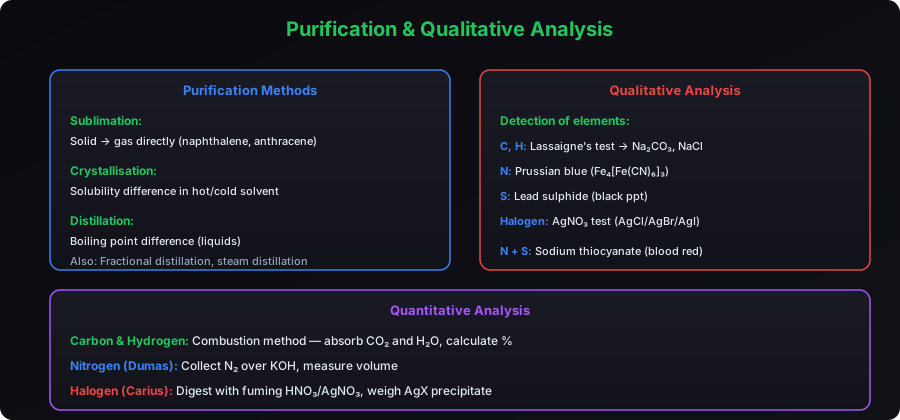
Sublimation
For solid compounds that sublime (naphthalene, anthracene).
Crystallisation
Solubility differences in hot/cold solvent. Most common method.
Distillation
Separation based on boiling point differences. For liquids.
Chromatography
Separation based on differential adsorption on stationary phase.
8.10 Qualitative Analysis
Elemental analysis of organic compounds is done by Lassaigne's test: sodium fusion converts covalently bonded elements (C, H, N, S, halogens) into ionic form for detection.
- Carbon & Hydrogen: Detected by forming CO₂ (lime water) and H₂O (anhydrous CuSO₄)
- Nitrogen: Prussian blue colour with FeSO₄ (formation of Fe₄[Fe(CN)₆]₃)
- Sulphur: Lead acetate test → black PbS or sodium nitroprusside test → violet colour
- Halogens: AgNO₃ test → white ppt (Cl), pale yellow ppt (Br), yellow ppt (I)
Summary
Organic chemistry is the study of carbon compounds. Carbon's tetravalence and ability to form chains, branches, and rings gives rise to millions of compounds. Structural representations include complete, condensed, bond-line, and 3D formulas. Compounds are classified as acyclic, cyclic (alicyclic, aromatic), or by functional groups. IUPAC nomenclature provides a systematic naming system. Isomerism accounts for different compounds with the same molecular formula. Electronic displacements (inductive, resonance, hyperconjugation) influence reactivity. Organic reactions include substitution, addition, elimination, and rearrangement, proceeding via free radical, electrophilic, or nucleophilic mechanisms. Purification methods (sublimation, crystallisation, distillation, chromatography) and qualitative/quantitative analysis (Lassaigne's test, combustion) are essential tools.