Microbes in Human Welfare
From household curd to industrial antibiotics, sewage treatment to biogas — exploring the indispensable role of microorganisms in everyday life
In this chapter
Microorganisms — or microbes — are among the most abundant and influential life forms on Earth. Found in soil, water, air, within our bodies, and even in extreme environments such as volcanic geysers and deep beneath layers of snow, these tiny organisms play a far greater role in human life than most people realise. Microbes include protozoa, bacteria, fungi, microscopic animals, viruses, viroids, and prions.
In the previous chapter you studied how microbes can cause disease. However, this chapter reveals the other side of the story: the many beneficial contributions of microbes to human welfare — from the food we eat to the medicines that save our lives, and from treating our sewage to producing clean energy.
Microbes like bacteria and fungi can be grown on nutritive media to form colonies that are visible to the naked eye. Such cultures are routinely used in microbiology laboratories for research and diagnostic purposes.
8.1 Microbes in Household Products
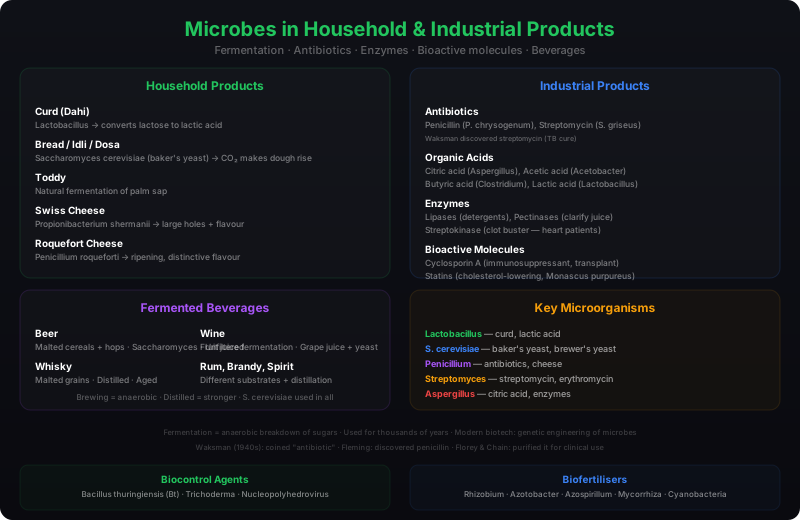
We interact with microbes and their products on a daily basis, often without even realising it. The transformation of milk into curd, the rising of dough for bread and idli, and the production of cheese and fermented beverages are all driven by microbial activity.
Curd and Lactic Acid Bacteria
A striking everyday example is the conversion of milk into curd. Microorganisms such as Lactobacillus and other lactic acid bacteria (LAB) grow in milk and convert it to curd. During their growth, these bacteria produce acids that coagulate and partially digest milk proteins. When a small amount of curd is added to fresh milk as an inoculum (or starter), it introduces millions of LAB cells that multiply at suitable temperatures and convert the entire volume of milk to curd. This process also enhances the nutritional quality of milk by increasing its vitamin B₁₂ content. In the human stomach too, LAB play a beneficial role by checking the growth of disease-causing microbes.
Fermented Dough Products
The dough used for preparing foods like dosa and idli is fermented by bacteria, and the characteristic puffed-up appearance of the dough is due to the production of CO₂ gas during fermentation. The bacteria responsible for this fermentation originate naturally from the environment and the ingredients themselves. Similarly, the dough used for making bread is fermented using baker's yeast (Saccharomyces cerevisiae), which also produces CO₂ to give bread its light, airy texture.
Traditional Fermented Foods and Drinks
Many traditional Indian foods and beverages rely on microbial fermentation. Toddy, a traditional drink from parts of southern India, is produced by fermenting palm sap. Microbes are also employed to ferment fish, soyabean, and bamboo shoots to create a variety of regional foods.
Cheese Production
Cheese is one of the oldest foods in which microbes were deliberately used. Different varieties of cheese are distinguished by their characteristic texture, flavour, and taste — qualities that arise from the specific microbes employed in their production. For example, the large holes in Swiss cheese are caused by the bacterium Propionibacterium sharmanii, which produces copious amounts of CO₂ during fermentation. Roquefort cheese is ripened by growing a specific fungus on it, which imparts its distinctive flavour.
Curd
Lactobacillus (LAB) converts milk to curd, producing lactic acid that coagulates milk proteins and increases vitamin B₁₂ content.
Bread & Idli
Yeast (S. cerevisiae) and bacteria ferment dough, producing CO₂ that makes the dough rise and gives a soft texture.
Cheese
Specific microbes give cheese its characteristic flavour and texture — e.g., P. sharmanii for Swiss cheese holes.
Fermented Drinks
Toddy from palm sap and fermented fish, soyabean, and bamboo shoots all rely on natural microbial fermentation.
8.2 Microbes in Industrial Products
Beyond household uses, microbes are harnessed on an industrial scale to produce a wide range of products — from beverages and antibiotics to enzymes, organic acids, and bioactive molecules of immense medical importance.
8.2.1 Fermented Beverages
Yeasts, particularly Saccharomyces cerevisiae, have been used since ancient times for producing beverages such as wine, beer, whisky, brandy, and rum. The same yeast used in bread-making — commonly called brewer's yeast — is used to ferment malted cereals and fruit juices, producing ethanol as the primary product.
Depending on the raw material and the processing method, different types of alcoholic drinks are obtained. Wine and beer are produced without distillation — they retain the ethanol produced directly by fermentation. In contrast, whisky, brandy, and rum are produced by distillation of the fermented broth, which concentrates the ethanol content.
Without distillation: Wine (from grape juice), Beer (from malted cereals)
With distillation: Whisky (from malted grains), Brandy (from wine), Rum (from sugarcane molasses)
8.2.2 Antibiotics
Antibiotics stand among the most transformative discoveries of the twentieth century. The word itself is derived from Greek: anti (against) + bio (life) — meaning "against life" when referring to disease-causing organisms. From the perspective of human health, however, antibiotics are very much "pro-life."
An antibiotic is a chemical substance produced by a microbe that can kill or inhibit the growth of other (disease-causing) microbes.
Alexander Fleming made a chance discovery while working with Staphylococci bacteria — he noticed a mould growing on one of his unwashed culture plates, around which the bacteria could not grow. He identified the antibacterial chemical produced by the mould and named it Penicillin, after the mould Penicillium notatum.
Later, Ernest Chain and Howard Florey established its full potential as an effective antibiotic. Penicillin was extensively used to treat American soldiers wounded in World War II. Fleming, Chain, and Florey were awarded the Nobel Prize in 1945 for this discovery.
After Penicillin, numerous other antibiotics were purified from various microbes. These drugs revolutionised our ability to treat once-devastating diseases like plague, whooping cough (kali khansi), diphtheria (galghotu), and leprosy (kusht rog), which had previously claimed millions of lives worldwide.
8.2.3 Chemicals, Enzymes and other Bioactive Molecules
Microbes are employed for the commercial and industrial production of organic acids, alcohols, and enzymes.
Organic Acid Producers
| Microbe | Product |
|---|---|
| Aspergillus niger (fungus) | Citric acid |
| Acetobacter aceti (bacterium) | Acetic acid |
| Clostridium butylicum (bacterium) | Butyric acid |
| Lactobacillus (bacterium) | Lactic acid |
| Saccharomyces cerevisiae (yeast) | Ethanol |
Industrial Enzymes
- Lipases — used in detergent formulations to break down oily stains from laundry.
- Pectinases and Proteases — used to clarify bottled fruit juices, making them clearer and more visually appealing than home-made juices.
- Streptokinase — produced by Streptococcus and modified through genetic engineering; used as a clot buster to dissolve blood clots in patients who have suffered myocardial infarction (heart attack).
Other Important Bioactive Molecules
- Cyclosporin A — produced by the fungus Trichoderma polysporum; used as an immunosuppressive agent in organ-transplant patients to prevent immune rejection of the transplanted organ.
- Statins — produced by the yeast Monascus purpureus; commercialised as blood-cholesterol lowering agents. Statins work by competitively inhibiting the enzyme responsible for cholesterol synthesis in the body.
8.3 Microbes in Sewage Treatment

Cities and towns generate enormous quantities of waste water every day. A major component of this sewage is human excreta, and it contains large amounts of organic matter and pathogenic microbes. This municipal waste water cannot be discharged directly into natural water bodies like rivers and streams — it must first be treated. Sewage treatment plants (STPs) use natural microbial processes to purify this water.
The key strategy relies on the heterotrophic microbes naturally present in sewage, which are encouraged to break down the organic matter. Treatment proceeds in two main stages:
Primary Treatment
This stage involves purely physical removal of particles — both large and small — from the sewage through filtration and sedimentation. Floating debris is removed by sequential filtration, and grit (soil and small pebbles) is removed by allowing it to settle. All solids that settle form the primary sludge, while the clear liquid above forms the effluent. This effluent is then passed on for secondary treatment.
Secondary Treatment (Biological Treatment)
The primary effluent is channelled into large aeration tanks, where it is continuously agitated mechanically and air is pumped in. This provides ideal conditions for the vigorous growth of useful aerobic microbes. These microbes grow as flocs — masses of bacteria associated with fungal filaments that form mesh-like structures. As the flocs grow, they consume the major part of the organic matter in the effluent.
BOD refers to the amount of oxygen that would be consumed if all the organic matter in one litre of water were oxidised by bacteria. It is a direct measure of the organic pollution load in water. The BOD test measures the rate of uptake of oxygen by microorganisms in a water sample. The greater the BOD of wastewater, the higher is its polluting potential.
As the microbes grow and consume organic matter, the BOD of the effluent drops significantly. Once the BOD is sufficiently reduced, the effluent is passed into a settling tank where the bacterial flocs are allowed to sediment. This sediment is called activated sludge.
A small portion of the activated sludge is pumped back into the aeration tank to serve as the inoculum. The remaining bulk of the sludge is transferred to large anaerobic sludge digesters, where different kinds of anaerobic bacteria break down the bacteria and fungi in the sludge. During this digestion, the bacteria produce a mixture of gases — methane, hydrogen sulphide, and carbon dioxide — collectively known as biogas, which can be used as a source of energy.
The effluent from secondary treatment is generally released into natural water bodies like rivers and streams. This methodology of microbial sewage treatment has been practised for over a century worldwide, and to date, no man-made technology has been able to rival its effectiveness.
Due to increasing urbanisation, sewage production has surged, but the number of treatment plants has not kept pace. Untreated sewage is often discharged directly into rivers, causing severe pollution and a rise in water-borne diseases. The Ganga Action Plan and Yamuna Action Plan, initiated by the Ministry of Environment and Forests, aim to build a large number of sewage treatment plants so that only treated water is released into these rivers.
8.4 Microbes in Production of Biogas
Biogas is a mixture of gases — predominantly methane — produced by microbial activity and usable as a fuel. The type of gas produced depends on the microbes and the organic substrates they metabolise. While fermentation of dough, cheese-making, and beverage production mainly generate CO₂, certain bacteria that grow anaerobically on cellulosic material produce large quantities of methane along with CO₂ and H₂.
Methanogens
These methane-producing bacteria are collectively called methanogens. A common example is Methanobacterium. Methanogens are found in anaerobic sludge during sewage treatment and also in the rumen — a specialised part of the stomach of cattle. The rumen harbours large quantities of cellulosic material from the cattle's food, and methanogens help break down this cellulose, playing a vital role in the animal's nutrition. Humans, unlike cattle, cannot digest cellulose.
Because cattle dung (commonly called gobar) is rich in methanogens, it can be used to generate biogas — popularly known as gobar gas.
The Biogas Plant
A typical biogas plant consists of a large, underground concrete tank (the digester) where cattle dung is fed as a slurry. The sealed tank provides anaerobic conditions ideal for methanogens to thrive. As the microbes break down the organic matter, biogas is produced and collected under a floating cover placed over the slurry. This cover rises as gas accumulates.
- An outlet pipe channels the biogas to nearby houses for cooking and lighting.
- A separate outlet removes the spent slurry, which can be used directly as a fertiliser.
- Cattle dung is abundantly available in rural areas, making biogas plants particularly well-suited for village settings.
The technology of biogas production was developed in India mainly through the efforts of the Indian Agricultural Research Institute (IARI) and the Khadi and Village Industries Commission (KVIC).
8.5 Microbes as Biocontrol Agents
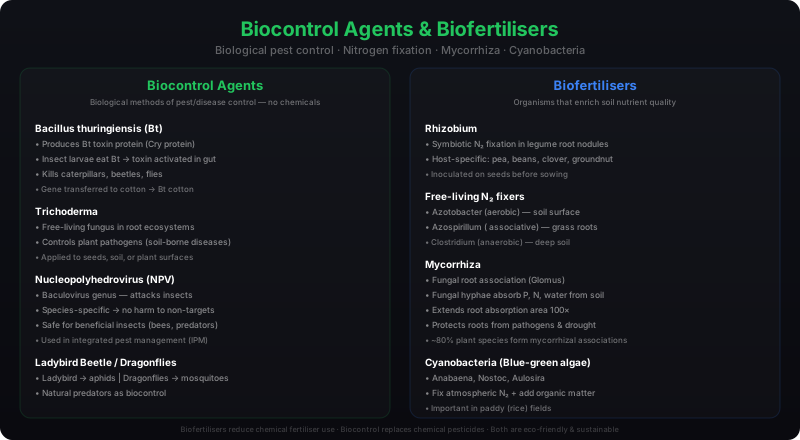
Biocontrol refers to the use of biological methods for controlling plant diseases and pests. In modern agriculture, the over-reliance on chemical insecticides and pesticides has caused serious problems — these chemicals are toxic to humans and animals alike, pollute the soil and groundwater, and contaminate fruits, vegetables, and crop plants.
The Philosophy of Biological Control
Biological control takes a fundamentally different approach: rather than eradicating pests with chemicals, it relies on natural predation and ecological balance. A core principle of organic farming is that biodiversity furthers health — the more variety a landscape has, the more sustainable it is. Pests are not eliminated but kept at manageable levels through a complex system of checks and balances within a living, vibrant ecosystem.
This holistic approach requires understanding the webs of interaction among organisms that constitute the field's fauna and flora. The organic farmer recognises that eradicating creatures called "pests" is not only difficult but undesirable, because the beneficial predatory and parasitic insects that depend on them as food or hosts would also perish. Thus, biocontrol measures reduce our dependence on toxic chemicals.
Examples of Biocontrol Agents
Ladybird Beetle
The familiar red-and-black spotted beetle feeds on aphids, effectively controlling their populations in gardens and farms.
Dragonflies
Dragonflies are natural predators of mosquitoes, helping to reduce mosquito populations in wetland habitats.
Bacillus thuringiensis (Bt)
Available as dried spores in sachets, Bt is mixed with water and sprayed on plants. When caterpillars eat the treated foliage, the Bt toxin released in their gut kills them — without harming other insects. Bt-cotton is a transgenic crop expressing Bt toxin genes, cultivated in several Indian states.
Trichoderma Fungi
Free-living fungi common in root ecosystems; effective biocontrol agents against several plant pathogens.
Baculoviruses
Pathogens that attack insects and other arthropods. Most used as biocontrol agents belong to the genus Nucleopolyhedrovirus — they are excellent candidates for species-specific, narrow-spectrum insecticidal applications.
8.6 Microbes as Biofertilisers
The enormous demand for agricultural produce has led to widespread use of chemical fertilisers, causing significant soil and water pollution. There is now growing pressure to switch to organic farming, which emphasises the use of biofertilisers — organisms that enrich the nutrient quality of soil. The main sources of biofertilisers are bacteria, fungi, and cyanobacteria.
Nitrogen-Fixing Bacteria
You have already studied the symbiotic association of Rhizobium with the roots of leguminous plants. These bacteria fix atmospheric nitrogen into organic forms that the plant can use as a nutrient. Other bacteria fix atmospheric nitrogen while living free in the soil — examples include Azospirillum and Azotobacter — thereby enriching the soil's nitrogen content.
Mycorrhiza
Fungi form mycorrhizal associations with many plants. Members of the genus Glomus are particularly important. In these associations, the fungal symbiont absorbs phosphorus from the soil and transfers it to the plant. Plants with mycorrhizal associations also benefit from:
- Increased resistance to root-borne pathogens
- Greater tolerance to salinity and drought
- Overall enhancement in plant growth and development
In return, the fungus receives organic nutrients from the plant — a classic example of mutualism.
Cyanobacteria
Cyanobacteria (blue-green algae) are autotrophic microbes widely distributed in both aquatic and terrestrial environments. Many can fix atmospheric nitrogen — notable examples include Anabaena, Nostoc, and Oscillatoria. In paddy fields, cyanobacteria serve as an especially important biofertiliser, adding organic matter to the soil and increasing its fertility.
Currently, a number of biofertilisers are available commercially in the Indian market. Farmers use them regularly to replenish soil nutrients and reduce dependence on chemical fertilisers, contributing to more sustainable agricultural practices.
8.7 Summary
• Microbes are essential components of life on Earth; many are enormously beneficial to human beings, not just pathogenic.
• Lactic acid bacteria (LAB) convert milk into curd, and yeast (Saccharomyces cerevisiae) ferments dough for bread, idli, and dosa.
• Microbes produce industrial products including fermented beverages (wine, beer, whisky), antibiotics (Penicillin was the first, discovered by Fleming), organic acids, enzymes, and bioactive molecules like cyclosporin A and statins.
• Sewage treatment involves primary (physical) and secondary (biological) stages; aerobic microbes in aeration tanks form flocs that reduce BOD; anaerobic digestion of sludge produces biogas.
• Methanogens (e.g., Methanobacterium) produce methane-rich biogas; cattle dung is a key feedstock. Biogas plants were developed in India through IARI and KVIC.
• Biocontrol agents (Ladybird, Dragonflies, Bt, Trichoderma, Baculoviruses) control pests without toxic chemicals.
• Biofertilisers — nitrogen-fixing bacteria (Rhizobium, Azospirillum, Azotobacter), mycorrhizal fungi (Glomus), and cyanobacteria (Anabaena, Nostoc) — enrich soil fertility organically.