Plant Growth and Development
Understanding the remarkable processes that govern how plants grow, differentiate, and develop throughout their entire lifespan
In this chapter
Have you ever wondered where and how structures like roots, stems, leaves, flowers, fruits and seeds arise in an orderly sequence? By now, you are familiar with the terms seed, seedling, plantlet, and mature plant. Trees continue to increase in height or girth over a period of time — yet the leaves, flowers and fruits of the same tree not only have limited dimensions but also appear and fall periodically, sometimes repeatedly.
Why does the vegetative phase precede flowering in a plant? All plant organs are made up of a variety of tissues — is there any relationship between the structure of a cell, a tissue, an organ and the function they perform? All cells of a plant are descendants of the zygote, yet they have different structural and functional attributes. Development is the sum of two processes: growth and differentiation. The development of a mature plant from a zygote follows a precise and highly ordered succession of events, producing roots, leaves, branches, flowers, fruits, and seeds — and eventually the plant dies.
The first step in the process of plant growth is seed germination. The seed germinates when favourable conditions for growth exist in the environment. In the absence of such conditions, the seeds do not germinate and go into a period of suspended growth or rest. Once favourable conditions return, the seeds resume metabolic activities and growth takes place. In this chapter, we shall also study some of the factors which govern and control these developmental processes — both intrinsic (internal) and extrinsic (external) to the plant.

13.1 Growth
Growth is regarded as one of the most fundamental and conspicuous characteristics of a living being. It can be defined as an irreversible permanent increase in size of an organ or its parts or even of an individual cell. Generally, growth is accompanied by metabolic processes (both anabolic and catabolic) that occur at the expense of energy. Therefore, for example, expansion of a leaf is growth. How would you describe the swelling of a piece of wood when placed in water? That is not growth — it is a reversible physical change.
13.1.1 Plant Growth Generally is Indeterminate
Plant growth is unique because plants retain the capacity for unlimited growth throughout their life. This ability is due to the presence of meristems at certain locations in their body. The cells of such meristems have the capacity to divide and self-perpetuate. The product, however, soon loses the capacity to divide and such cells make up the plant body. This form of growth wherein new cells are always being added to the plant body by the activity of the meristem is called the open form of growth.
You have studied about the root apical meristem and the shoot apical meristem — they are responsible for the primary growth of the plants and principally contribute to the elongation of the plants along their axis. In dicotyledonous plants and gymnosperms, the lateral meristems — vascular cambium and cork-cambium — appear later in life. These are the meristems that cause the increase in the girth of the organs in which they are active. This is known as secondary growth of the plant.
↑
Vascular cambium — secondary growth (increase in girth)
↓
Root apical meristem — primary growth (elongation)
13.1.2 Growth is Measurable
Growth, at a cellular level, is principally a consequence of increase in the amount of protoplasm. Since increase in protoplasm is difficult to measure directly, one generally measures some quantity which is more or less proportional to it. Growth is, therefore, measured by a variety of parameters some of which are:
- Increase in fresh weight
- Increase in dry weight
- Increase in length
- Increase in area
- Increase in volume
- Increase in cell number
One single maize root apical meristem can give rise to more than 17,500 new cells per hour, whereas cells in a watermelon may increase in size by up to 3,50,000 times. In the former, growth is expressed as increase in cell number; the latter expresses growth as increase in size of the cell. While the growth of a pollen tube is measured in terms of its length, an increase in surface area denotes the growth in a dorsiventral leaf.
13.1.3 Phases of Growth
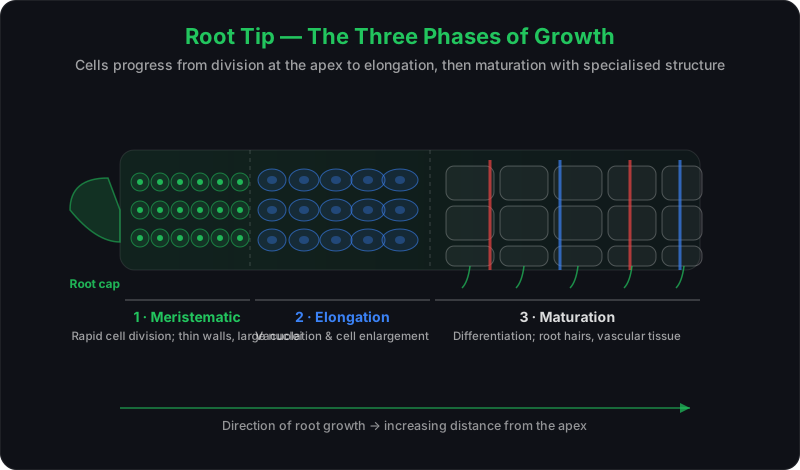
The period of growth is generally divided into three phases, namely, meristematic, elongation, and maturation. Let us understand this by looking at the root tips.
Meristematic Phase
The constantly dividing cells at the root apex and shoot apex represent this phase. These cells are rich in protoplasm, possess large conspicuous nuclei, and their cell walls are primary in nature — thin and cellulosic with abundant plasmodesmatal connections.
Elongation Phase
The cells proximal (just next, away from the tip) to the meristematic zone represent the phase of elongation. Increased vacuolation, cell enlargement and new cell wall deposition are the characteristics of the cells in this phase.
Maturation Phase
Further away from the apex, more proximal to the phase of elongation, lies the portion which is undergoing maturation. The cells of this zone attain their maximal size in terms of wall thickening and protoplasmic modifications.
13.1.4 Growth Rates
The increased growth per unit time is termed as growth rate. Thus, rate of growth can be expressed mathematically. An organism, or a part of the organism can produce more cells in a variety of ways. The growth rate shows an increase that may be arithmetic or geometrical.
Arithmetic Growth
In arithmetic growth, following mitotic cell division, only one daughter cell continues to divide while the other differentiates and matures. The simplest expression of arithmetic growth is exemplified by a root elongating at a constant rate. On plotting the length of the organ against time, a linear curve is obtained. Mathematically, it is expressed as:
L0 = length at time 'zero'
r = growth rate / elongation per unit time
Geometric Growth
In most systems, the initial growth is slow (lag phase), and it increases rapidly thereafter — at an exponential rate (log or exponential phase). Here, both the progeny cells following mitotic cell division retain the ability to divide and continue to do so. However, with limited nutrient supply, the growth slows down leading to a stationary phase. If we plot the parameter of growth against time, we get a typical sigmoid or S-curve. A sigmoid curve is a characteristic of living organisms growing in a natural environment. It is typical for all cells, tissues and organs of a plant.
W0 = initial size at the beginning of the period
r = growth rate
t = time of growth
e = base of natural logarithms
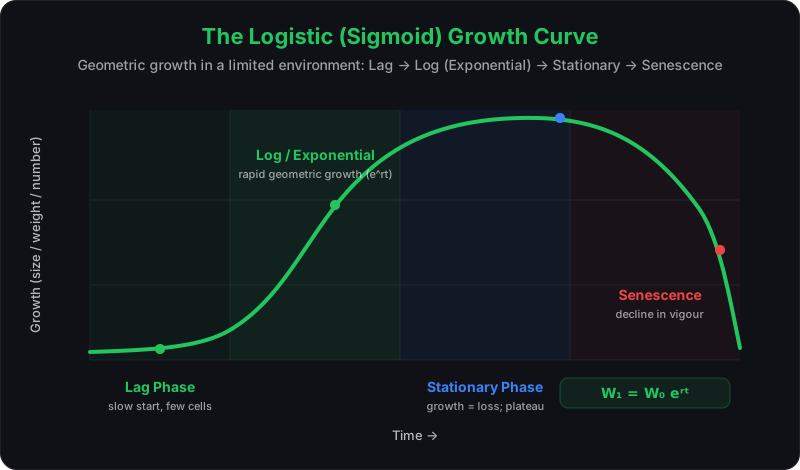
Here, r is the relative growth rate and is also the measure of the ability of the plant to produce new plant material, referred to as efficiency index. Hence, the final size of W1 depends on the initial size, W0.
Quantitative comparisons between the growth of living systems can be made in two ways: (i) measurement and the comparison of total growth per unit time is called the absolute growth rate. (ii) The growth of the given system per unit time expressed on a common basis, e.g., per unit initial parameter, is called the relative growth rate.
13.1.5 Conditions for Growth
Several conditions are necessary for plant growth. The essential elements include water, oxygen, and nutrients. Plant cells grow in size by cell enlargement which in turn requires water. Turgidity of cells helps in extension growth. Thus, plant growth and further development is intimately linked to the water status of the plant. Water also provides the medium for enzymatic activities needed for growth.
Oxygen helps in releasing metabolic energy essential for growth activities. Nutrients (macro and micro essential elements) are required by plants for the synthesis of protoplasm and act as source of energy. In addition, every plant organism has an optimum temperature range best suited for its growth. Any deviation from this range could be detrimental to its survival. Environmental signals such as light and gravity also affect certain phases/stages of growth.
13.2 Differentiation, Dedifferentiation and Redifferentiation
The cells derived from root apical and shoot-apical meristems and cambium differentiate and mature to perform specific functions. This act leading to maturation is termed as differentiation. During differentiation, cells undergo few to major structural changes both in their cell walls and protoplasm. For example, to form a tracheary element, the cells would lose their protoplasm. They also develop a very strong, elastic, lignocellulosic secondary cell walls, to carry water to long distances even under extreme tension.
Plants show another interesting phenomenon. The living differentiated cells, that by now have lost the capacity to divide, can regain the capacity of division under certain conditions. This phenomenon is termed as dedifferentiation. For example, formation of meristems — interfascicular cambium and cork cambium — from fully differentiated parenchyma cells.
While doing so, such meristems/tissues are able to divide and produce cells that once again lose the capacity to divide but mature to perform specific functions, i.e., get redifferentiated. Consider the tissues in a woody dicotyledonous plant that are the products of redifferentiation — these include the secondary xylem, secondary phloem, and periderm.
Even differentiation in plants is open, because cells/tissues arising out of the same meristem have different structures at maturity. The final structure at maturity of a cell/tissue is also determined by the location of the cell within. For example, cells positioned away from root apical meristems differentiate as root-cap cells, while those pushed to the periphery mature as epidermis.
13.3 Development
Development is a term that includes all changes that an organism goes through during its life cycle — from germination of the seed to senescence. It is applicable to tissues and organs as well.
Plants follow different pathways in response to environment or phases of life to form different kinds of structures. This ability is called plasticity. A classic example is heterophylly in cotton, coriander and larkspur. In such plants, the leaves of the juvenile plant are different in shape from those in mature plants. On the other hand, difference in shapes of leaves produced in air and those produced in water in buttercup also represent the heterophyllous development due to environment. This phenomenon of heterophylly is an example of plasticity.
Thus, growth, differentiation and development are very closely related events in the life of a plant. Broadly, development is considered as the sum of growth and differentiation. Development in plants (i.e., both growth and differentiation) is under the control of intrinsic and extrinsic factors. The former includes both intracellular (genetic) or intercellular factors (chemicals such as plant growth regulators) while the latter includes light, temperature, water, oxygen, nutrition, etc.
Meristematic cells → Cell Division → Plasmatic Growth → Expansion (Elongation) → Differentiation → Maturation → Mature Cell → Senescence → Death. This sequence represents the complete developmental pathway of a plant cell.
13.4 Plant Growth Regulators
13.4.1 Characteristics
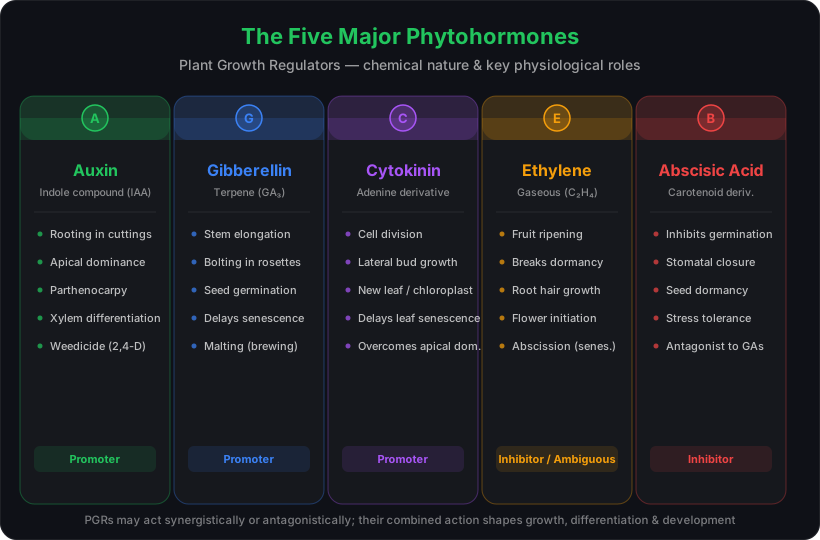
The plant growth regulators (PGRs) are small, simple molecules of diverse chemical composition. They could be:
- Indole compounds — indole-3-acetic acid (IAA)
- Adenine derivatives — N6-furfurylamino purine (kinetin)
- Derivatives of carotenoids — abscisic acid (ABA)
- Terpenes — gibberellic acid (GA3)
- Gases — ethylene (C2H4)
Plant growth regulators are variously described as plant growth substances, plant hormones or phytohormones in literature.
| Category | Function | Examples |
|---|---|---|
| Growth Promoters | Cell division, cell enlargement, pattern formation, tropic growth, flowering, fruiting, seed formation | Auxins, Gibberellins, Cytokinins |
| Growth Inhibitors | Response to wounds and stresses; dormancy, abscission | Abscisic acid (ABA) |
| Both / Ambiguous | Largely an inhibitor of growth activities | Ethylene (C2H4) |
13.4.2 The Discovery of Plant Growth Regulators
Interestingly, the discovery of each of the five major groups of PGRs has been accidental.
13.4.3 Physiological Effects of Plant Growth Regulators
13.4.3.1 Auxins
Auxins (from Greek auxein: to grow) was first isolated from human urine. The term 'auxin' is applied to the indole-3-acetic acid (IAA), and to other natural and synthetic compounds having certain growth regulating properties. They are generally produced by the growing apices of the stems and roots, from where they migrate to the regions of their action.
Auxins like IAA and indole butyric acid (IBA) have been isolated from plants. NAA (naphthalene acetic acid) and 2,4-D (2,4-dichlorophenoxyacetic acid) are synthetic auxins. All these auxins have been used extensively in agricultural and horticultural practices.
Key physiological effects of auxins:
- Initiate rooting in stem cuttings, widely used for plant propagation
- Promote flowering, e.g., in pineapples
- Help to prevent fruit and leaf drop at early stages but promote the abscission of older mature leaves and fruits
- In most higher plants, the growing apical bud inhibits the growth of the lateral (axillary) buds — a phenomenon called apical dominance. Removal of shoot tips (decapitation) usually results in the growth of lateral buds — widely applied in tea plantations and hedge-making
- Induce parthenocarpy, e.g., in tomatoes
- Widely used as herbicides — 2,4-D is used to kill dicotyledonous weeds without affecting mature monocotyledonous plants, useful for weed-free lawns
- Control xylem differentiation and help in cell division
13.4.3.2 Gibberellins
Gibberellins are another kind of promotory PGR. There are more than 100 gibberellins reported from widely different organisms such as fungi and higher plants. They are denoted as GA1, GA2, GA3 and so on. However, Gibberellic acid (GA3) was one of the first gibberellins to be discovered and remains the most intensively studied form. All GAs are acidic. They produce a wide range of physiological responses in the plants.
- Their ability to cause an increase in length of axis is used to increase the length of grape stalks
- Cause fruits like apple to elongate and improve its shape
- They also delay senescence — thus the fruits can be left on the tree longer so as to extend the market period
- GA3 is used to speed up the malting process in brewing industry
- Spraying sugarcane crop with gibberellins increases the length of the stem, thus increasing the yield by as much as 20 tonnes per acre
- Spraying juvenile conifers with GAs hastens the maturity period, thus leading to early seed production
- Gibberellins also promote bolting (internode elongation just prior to flowering) in beet, cabbages and many plants with rosette habit
13.4.3.3 Cytokinins
Cytokinins have specific effects on cytokinesis, and were discovered as kinetin (a modified form of adenine, a purine) from the autoclaved herring sperm DNA. Kinetin does not occur naturally in plants. Search for natural substances with cytokinin-like activities led to the isolation of zeatin from corn-kernels and coconut milk. Since the discovery of zeatin, several naturally occurring cytokinins, and some synthetic compounds with cell division promoting activity, have been identified.
Natural cytokinins are synthesised in regions where rapid cell division occurs, for example, root apices, developing shoot buds, young fruits etc. It helps to produce new leaves, chloroplasts in leaves, lateral shoot growth and adventitious shoot formation. Cytokinins help overcome the apical dominance. They promote nutrient mobilisation which helps in the delay of leaf senescence.
13.4.3.4 Ethylene
Ethylene is a simple gaseous PGR. It is synthesised in large amounts by tissues undergoing senescence and ripening fruits. Influences of ethylene on plants include horizontal growth of seedlings, swelling of the axis and apical hook formation in dicot seedlings. Ethylene promotes senescence and abscission of plant organs especially of leaves and flowers.
Ethylene is highly effective in fruit ripening. It enhances the respiration rate during ripening of the fruits. This rise in rate of respiration is called respiratory climacteric.
- Ethylene breaks seed and bud dormancy, initiates germination in peanut seeds, sprouting of potato tubers
- Ethylene promotes rapid internode/petiole elongation in deep water rice plants — helps leaves/upper parts of the shoot to remain above water
- Ethylene also promotes root growth and root hair formation, thus helping the plants to increase their absorption surface
- Ethylene is used to initiate flowering and for synchronising fruit-set in pineapples — it also induces flowering in mango
- The most widely used compound as source of ethylene is ethephon. Ethephon in an aqueous solution is readily absorbed and transported within the plant and releases ethylene slowly
- Ethephon hastens fruit ripening in tomatoes and apples and accelerates abscission in flowers and fruits (thinning of cotton, cherry, walnut)
- It promotes female flowers in cucumbers thereby increasing the yield
13.4.3.5 Abscisic Acid
Abscisic acid (ABA) was discovered for its role in regulating abscission and dormancy. But like other PGRs, it also has other wide ranging effects on plant growth and development. It acts as a general plant growth inhibitor and an inhibitor of plant metabolism.
- ABA inhibits seed germination
- ABA stimulates the closure of stomata and increases the tolerance of plants to various kinds of stresses — therefore, it is also called the stress hormone
- ABA plays an important role in seed development, maturation and dormancy
- By inducing dormancy, ABA helps seeds to withstand desiccation and other factors unfavourable for growth
- In most situations, ABA acts as an antagonist to GAs
For any and every phase of growth, differentiation and development of plants, one or the other PGR has some role to play. Such roles could be complementary or antagonistic. These could be individualistic or synergistic. Similarly, there are a number of events in the life of a plant where more than one PGR interact to affect that event, e.g., dormancy in seeds/buds, abscission, senescence, apical dominance, etc.
Remember, the role of PGR is of only one kind of intrinsic control. Along with genomic control and extrinsic factors, they play an important role in plant growth and development. Many of the extrinsic factors such as temperature and light, control plant growth and development via PGR — events such as vernalisation, flowering, dormancy, seed germination, and plant movements.
13.5 Summary
• Growth is one of the most conspicuous events in any living organism. It is an irreversible increase expressed in parameters such as size, area, length, height, volume, cell number etc. It conspicuously involves increased protoplasmic material.
• In plants, meristems are the sites of growth. Root and shoot apical meristems, sometimes along with intercalary meristem, contribute to the elongation growth of plant axes. Growth is indeterminate in higher plants.
• Following cell division in root and shoot apical meristem cells, the growth could be arithmetic or geometrical. Growth may not be and generally is not sustained at a high rate throughout the life of cell/tissue/organ/organism. One can define three principle phases of growth — the lag, the log and the senescent phase.
• When a cell loses the capacity to divide, it leads to differentiation. Differentiation results in development of structures that is commensurate with the function the cells finally has to perform. A differentiated cell may dedifferentiate and then redifferentiate.
• Since differentiation in plants is open, the development could also be flexible, i.e., development is the sum of growth and differentiation. Plants exhibit plasticity in development.
• Plant growth and development are under the control of both intrinsic and extrinsic factors. Intercellular intrinsic factors are the chemical substances called plant growth regulators (PGR). There are diverse groups of PGRs in plants, principally belonging to five groups: auxins, gibberellins, cytokinins, abscisic acid and ethylene.
• These PGRs are synthesised in various parts of the plant; they control different differentiation and developmental events. Any PGR has diverse physiological effects on plants. Diverse PGRs also manifest similar effects. PGRs may act synergistically or antagonistically.
• Plant growth and development is also affected by light, temperature, nutrition, oxygen status, gravity and such external factors.